Responsible Gambling messaging: what the evidence actually shows

Written by: Rasmus Gripenfrid
When I asked my network how effective they believe RG messaging really is, pop-ups, alerts, reminders, the responses were telling. Half said "some effect, often overrated." One in five said "very effective if done right." Another one in five said "mostly ineffective." Even from a small sample (10 votes), that spread tells you something: the industry doesn't have a shared understanding of what RG messaging can and can't do.
So I went to research. Here's what I found, and what I think it means for how you design your player protection programme.
Do pop-up messages actually work?
The short answer: yes, but modestly and temporarily.
A 2021 meta-analysis by Bjørseth and colleagues synthesised 18 studies and found that pop-up messages produced moderate effects on both gambling behaviour and cognitions. The effect size for behavioural outcomes, things like money staked and number of spins, was Hedges' g = 0.505. For cognitive outcomes, such as correcting irrational beliefs about chance, the effect was slightly smaller at g = 0.413. Both are what researchers call "moderate" effects.
That's meaningful, especially for a low-cost, scalable tool. But there are important caveats.
Most of these studies were conducted in laboratory or simulated settings, not in real gambling environments. The few field trials that do exist suggest shorter session lengths and reduced spending in the moment, but the long-term picture remains unclear.
In other words: pop-ups can nudge behaviour. They're unlikely to transform it on their own.
What separates effective messages from noise?
This is where it gets interesting and where I think most operators still have room to improve.
A 2025 rapid evidence assessment by Gaudett, Pellizzari, Wood and Wohl, published in the Journal of Gambling Studies, reviewed the full landscape of RG messaging research.
Their findings are clear: generic slogans don't work. Static signage like "When the fun stops, stop" may raise a flicker of awareness, but it doesn't change play. Players tend to ignore these messages, and in some cases actively dislike them.
What does work?
Self-appraisal prompts, messages that ask the player to reflect on their own behaviour. Prompts like "What are you prepared to lose today?" or "Do you spend more now than you did a month ago?" engage a different cognitive process than a passive reminder. They invite the player to think, not just to click "OK."
The research also shows that message effectiveness varies significantly by audience.
Younger players appear to respond better to emotionally engaging, action-oriented content, while older players tend to prefer clear, supportive information.
Low-risk players often dismiss RG messages altogether, they see them as targeting "real" problem gamblers, not them. And at the other end of the spectrum, overly stigmatising messages, the kind that imply personal failure, can actively push at-risk players away from engaging with support.
The takeaway, as I see it, is that segmentation matters enormously.
One message for all players is almost certainly the wrong approach.
The SpillePuls case: what happens when you get personal
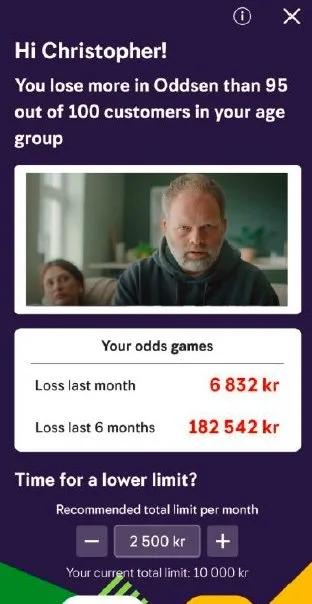
Example from Norsk Tipping Spillepuls
If there's a single real-world example that illustrates where the evidence is pointing, it's SpillePuls, Norsk Tipping's system for real-time, data-driven player interactions.
I want to highlight this case in particular because it brings together so much of what the research says should work and because we've been close to it. Our own clinical psychologist and responsible gambling expert, Dr Jakob Jonsson, was part of the interdisciplinary team that developed SpillePuls. Jakob's research on proactive outreach calls at Norsk Tipping, which demonstrated a sustained 30% reduction in spending among high-expenditure players, laid important groundwork for the personalized, data-driven approach that SpillePuls would go on to scale digitally.
SpillePuls isn't a pop-up in the traditional sense. It's a personalised digital dialogue, triggered by algorithms that monitor each player's behaviour against a set of risk markers. When a player's spending escalates, when they chase losses after a big win, or when their pattern shifts in ways that research associates with increased risk, SpillePuls initiates a brief, conversational interaction, right there in the customer journey.
The design is grounded in three objectives: make the player aware of what's happening, prompt them to reflect, and make it as easy as possible to take a protective action, like lowering a spending limit or transferring winnings to their bank account.
What makes SpillePuls stand out to me is the personalisation. Rather than showing every player the same message, the system draws on the individual's transaction data to show them their own numbers. If a sports bettor has been losing consistently on high-odds bets, SpillePuls might ask: "Is it time to adopt a new tactic?" and then show them a personalized chart of their losses over the past twelve months, their average odds, and their resulting win probability. It then offers a one-tap option to set a new, lower limit.
Norsk Tipping has developed SpillePuls iteratively since its launch in April 2021, using Randomised Controlled Trials (RCTs) to test every design choice. By mid-2023, the team had conducted 22 RCTs across different behavioural markers and events, testing 110 variants of interaction. The system had reached 450,000 unique customers and delivered more than 3.5 million individual interactions.
Three metrics stand out.
First, engagement: the proportion of players who read and completed the full interaction rose from around 60% in early pilots to 90–99% as the team optimised message length and design.
Second, acceptance: across all trials, customers scored the interactions 3.7 out of 5 for both relevance and usefulness, and only 2.4 out of 5 for disruption (on a reversed scale, meaning they found it minimally disruptive). Norsk Tipping has collected qualitative feedback from over 196,000 customers, including comments like "it feels meaningful and good to be seen", even when the player knew they were interacting with an automated system.
Third, action: on average, roughly 30% of players who received a SpillePuls interaction completed a concrete protective action, setting a new limit, transferring winnings, or taking a play break. That figure ranged from 2.4% in early pilots to nearly 50% in later, more refined versions. Event-triggered interactions performed particularly well: 35.7% of players who received a prompt to transfer casino winnings to their bank account did exactly that, and 47.4% of players returning from a 180-day play break chose to reduce their limit when prompted.
In several of the RCTs, the intervention group showed significantly lower spending compared to control groups.
SpillePuls won the European Lotteries Innovation Award in 2022, and the team continues to iterate, including pilot testing machine learning models to personalise which dialogue variant each player sees, based on the predicted likelihood of action.
What SpillePuls demonstrates, to me, is the gap between telling a player to "gamble responsibly" and actually equipping them to do so. The system combines behavioural science, interaction design, and real-time data into a scalable intervention that players accept, engage with, and act on.
It's the kind of approach I believe the industry needs far more of.
The bigger picture: what I think this means for your programme
Across the research, a consistent pattern emerges.
Generic, one-size-fits-all messaging is the least effective approach, yet it remains the most common.
The evidence strongly favours:
Messages that are timely — delivered during play, at moments of elevated risk, not before or after.
Messages that are personal — drawing on the player's own data to create relevance and self-recognition.
Messages that are self-reflective — prompting the player to evaluate their own behaviour rather than passively absorbing a warning.
Messages that are segmented — calibrated to the player's risk level, age, play style, and context.
Messages that are actionable — making it easy to do something concrete in the moment, not just feel informed.
And, this is the uncomfortable finding, messages designed for everyone tend to work for no one.
Low-risk players dismiss them as irrelevant. High-risk players find them stigmatising. The middle ground is almost impossible to hit with a single message.
The evidence doesn't say that RG messaging is useless. It says that lazy RG messaging is useless. When it's done well. evidence-based, data-driven, and personalized, it can meaningfully influence gambling behaviour in the short term and, as SpillePuls suggests, sustain player engagement and acceptance over time.
The question for operators isn't whether to use RG messaging. It's whether you're willing to invest in doing it properly.
This is what we work with every day at Sustainable Interaction. If you're looking to move from generic messaging to evidence-based, personalised player interactions we'd be happy to talk.
Sources & References
The claims in this article are based on peer-reviewed research, conference presentations, and official operator reports. Here are the key sources, with links so you can dig deeper.
On the effectiveness of RG pop-up messages:
Bjørseth, B., Simensen, J.O., Bjørnethun, A., Griffiths, M.D., Erevik, E.K., Leino, T. & Pallesen, S. (2021). The Effects of Responsible Gambling Pop-Up Messages on Gambling Behaviors and Cognitions: A Systematic Review and Meta-Analysis. Frontiers in Psychiatry, 11, 601800.
→ https://pmc.ncbi.nlm.nih.gov/articles/PMC7868407/
Key finding: Moderate effect sizes for both behavioural outcomes (Hedges' g = 0.505) and cognitive outcomes (g = 0.413). Effects are short-term and mostly demonstrated in laboratory settings.
On message content, segmentation, and what players actually respond to:
Gaudett, G.E., Pellizzari, P., Wood, R.T.A. & Wohl, M.J.A. (2025). Evaluating the Effectiveness of Responsible Gambling Messages: A Rapid Evidence Assessment. Journal of Gambling Studies, 41(3), 891–914.
→ https://pmc.ncbi.nlm.nih.gov/articles/PMC12361340/
Key finding: Self-appraisal messages outperform informational messages. Generic slogans like "When the fun stops, stop" are not evidence-based and show limited behavioural impact. Message segmentation by player risk level and demographics is critical.
On SpillePuls — Norsk Tipping's real-time player interaction system:
Sveen, T. (2023). SpillePuls at Norsk Tipping: Real-time, data-driven player interactions. Presentation at SNSUS 2023.
→ https://www.snsus.org/wp-content/uploads/2023/06/SNSUS-2023_Real-time-player-interactions.pdf
Key finding: 22 RCTs conducted, 110 variants tested, 450,000 unique customers reached. Interaction completion rose from 60% to 90–99%. Approximately 30% of players completed a protective action (range: 2.4%–50% across trials). Acceptance scores: 3.7/5 for relevance and usefulness.
World Lottery Association (2022). Artificial intelligence helps lotteries address problem gambling. Interview with Tanja Sveen, Norsk Tipping.
Context: Earlier data snapshot (12 RCTs, 80 variants at that point). 70–80% of users perceived the interactions as useful. Describes the development process, ML personalisation pilots, and specific interaction examples.
On SpillePuls — Norsk Tipping's public-facing tool description:
Norsk Tipping. Spillepuls.
→ https://www.norsk-tipping.no/spillevett/spillepuls
SpillePuls analyses a player's gaming patterns and evaluates risk using five weeks of play history combined with a self-assessment. Active for all Norsk Tipping customers. Uses a green/yellow/red status system.
On proactive outreach calls:
Jonsson, J., Hodgins, D.C., Munck, I. & Carlbring, P. (2019). Reaching out to big losers: A randomized controlled trial of brief motivational contact providing gambling expenditure feedback. Psychology of Addictive Behaviors, 33(3), 179–189.
→ https://doi.org/10.1037/adb0000447
Key finding: The original RCT. Phone-based motivational contact with high-expenditure players produced a 29% reduction in theoretical loss at 12-week follow-up.
Jonsson, J., Hodgins, D.C., Munck, I. & Carlbring, P. (2020). Reaching out to big losers leads to sustained reductions in gambling over 1 year: A randomized controlled trial of brief motivational contact. Addiction, 115(8), 1522–1531.
→ https://doi.org/10.1111/add.14982
Key finding: 12-month follow-up. The telephone group showed a sustained 30% reduction in theoretical loss (d = 0.44). The letter group showed a 13% reduction. Less than 1% of contacted players stopped gambling — they moderated, not quit.
Jonsson, J., Hodgins, D.C., Munck, I. & Carlbring, P. (2021). Reaching Out to Big Losers: How Different Types of Gamblers are Affected by a Brief Motivational Contact Initiated by the Gambling Provider. Journal of Gambling Studies, 37(2), 387–401.
→ https://link.springer.com/article/10.1007/s10899-020-09978-7
Key finding: Different gambler subtypes respond differently to phone vs. letter contact. Telephone contact works better for high-casino, high-sport and high-VLT players, while letters are a cost-effective alternative for high-lottery types.
Industry recognition:
European Lotteries (2022). 2022 EL Innovation Award goes to Norsk Tipping.
→ https://www.european-lotteries.org/news/2022-el-innovation-award-winner
SpillePuls won first place in the European Lotteries Innovation Awards 2022.